

Emotions play an essential role in sales and service. They determine purchasing decisions and customer satisfaction. How customers feel can be a decisive factor when making a purchase and in their level of satisfaction with the service they receive.
This is precisely why creating an emotional connection, or building rapport, with your customers is essential to improving sales performance and customer service quality.
But what does building rapport really mean? It’s about establishing and maintaining a positive relationship with your customers, so that they feel comfortable sharing their aspirations and concerns with you.
How do you create this emotional connection over the phone?
It all comes down to your voice. Emotions are conveyed through the physicality of your voice—changes in muscles, breath, and brain activity affect pitch, cadence, and inflection. In fact, your voice matters a great deal: When engaging in phone conversations, 87% of people form their impression of you primarily based on the tone of your voice, while just 13% is influenced by the actual words you use!
How you deliver your message matters more than the message itself.
So, it’s essential to use your voice effectively to convey the right emotional message, because it’s the only tool your customers have to assess your credibility and sincerity. A voice that resonates positively with your customers portrays you as knowledgeable and confident. Conversely, a voice they find unpleasant can drive them to disconnect.
In this blog post, we’ll explore how to harness the power of your voice to convey the right emotions to customers over the phone. Stay tuned for next month’s article on techniques to build rapport.

1. Adopt a good sitting posture to produce a better voice
It is essential to adopt a good posture!
Let’s begin with the basics – your posture matters, a lot!
Your voice isn’t just a vocal cord thing; it’s made of muscles, tissues, nerves, and more.
Fun facts: There are more nerves in the muscles of the larynx than any other muscles in your body (with the exception of your eyes)! And you’ve got more muscles above your shoulders than below them. That means when you talk, you’re using three-quarters of your body!
So, your body definitely plays a crucial role in how you sound. Your posture affects your breathing, and your breathing affects how you speak.
When you’ve got good posture, you can breathe more easily, and guess what? Your voice sounds clearer!

Bad posture automatically reduces the volume of the chest cavity and promotes shallow breathing from the upper chest. When you breathe using the upper chest, you fill only the upper lobes of your lungs that constitute only a small fraction of your lung capacity.
When your shoulders and chin are dropped the words are more muffled. This could give someone listening to you the impression that you sound unhappy, unconcerned or even bored and uninterested.
Get moving, get selling!
When you’re talking on the phone, here’s a nice trick to project a better voice: Stand up.
Standing puts less pressure on your diaphragm than sitting down, making your voice clearer and your sales pitch more convincing.
The act of standing can also make you feel more active, engaged, and ready to take on tasks. This psychological boost contributes to a perception of increased energy and confidence.
You’re also more likely to adopt a normal pattern of conversation. If you’re standing up you can freely gesticulate and this freedom of movement mimics a normal face to face conversation – resulting in more natural speech patterns.
| Remember, before you dial that number or take that call, straighten up – good posture radiates confidence all the way through the phone. |
2. Choose the correct tone to convey your emotions
In phone-based customer service and sales, mastering the right tone is crucial for creating a positive and productive interaction with your customers.
Let me hear your tone and I’ll tell you how you feel!
It’s not just a saying; it’s a golden rule in phone communication.
The way your voice sounds is an expression of your attitude, personality and character. Your tone tells others about your mood, sets the emotional context of the conversation, and can influence its outcome.
Your tone of voice is like a window into your mood and emotions. That’s why we can determine whether a person is happy, sad, bored, or anxious—just from the way they speak.
Emotions leak out through your tone, not your words.
In essence, we can ‘hear’ what isn’t being said and the feelings and emotions being communicated. So, listen closely to your customer’s tone; it’s a clue to their satisfaction or dissatisfaction.
How to navigate different scenarios with the appropriate tone:
Empathetic tone in frustrating situations:
When a customer is frustrated or facing challenges, adopting an empathetic tone can work wonders. It shows that you understand their concerns and are committed to finding a solution. Using a soothing and empathetic tone can help diffuse tension and build trust.

Confidence and enthusiasm for sales:
In sales calls, projecting confidence and enthusiasm through your tone is essential. An enthusiastic and confident tone can be persuasive, conveying your belief in the product or service you’re offering. It energizes the conversation and encourages customers to engage.
How to sound friendly? Simple: SMILE!
Smile affects your tone!
Research has shown that a smile influences how you speak, and yes it can be “heard” through the phone!
Physiologically, when you smile, the soft palate at the back of your mouth rises, making sound waves flow more smoothly. Smiling helps your voice come across as friendly, warm, and receptive.
Conversely, if you’re on the phone with a negative posture, a frown on your face, and a defensive attitude, it will show in your voice.
Smile boost your mood!
Studies have shown that even forced smiles can boost your mood.
When you smile, your brain releases a cascade of feel-good chemicals, including endorphins and serotonin. These neurotransmitters are natural mood lifters and pain relievers. So, by putting on a smile, you’re essentially giving your brain a chemical cue to elevate your mood.
Moreover, smiling – even if it’s not spontaneous – can reduce the release of stress hormones like cortisol. This can lead to a decrease in stress and anxiety levels, helping you feel more relaxed and in control.

Smile builds rapport!
Smiling often leads to more positive and upbeat communication. Your tone becomes warmer, and your words become more reassuring, creating a better experience for the customer. They’ll sense your enthusiasm, your willingness to help, and your confidence in the product or service you’re offering.
Even if a customer calls in with concerns, a smiling voice can reassure them and turn the call into an opportunity to address their needs. It’s a secret weapon for sales and customer service professionals to establish rapport and build trust.
So, remember, your smile isn’t just seen; it’s heard, and it can make all the difference in closing that deal or improving the experience that your customer receives.
| In customer service and sales, the tone of your voice plays a pivotal role in shaping the perception of your interactions. Being able to select the right tone allows you to effectively convey a range of emotions such as empathy, enthusiasm, or confidence and can make your customers feel welcome and valued. |
3. Lower your pitch to sound more in command
Pitch, simply put, refers to how high or low your voice sounds.
High-pitched voice:
People who speak in squeaky, high voices may come across as insecure, inexperienced, or lacking confidence. An overly high-pitched voice can give the impression of being junior or lacking authority, which is not the ideal image when dealing with customers seeking answers, especially when they are anxious.
Low-pitched voice:
Conversely, a lower-pitched voice is often associated with authority and command. If you aim to project a more authoritative image, consider lowering your voice a few notches. A lower voice is typically perceived as stronger, more confident, credible, and in control of the situation, as opposed to a high-pitched voice.
However, it’s important to find a balance. Going too low in pitch can lead to speech that sounds rumbling, unclear, or ponderous.
Variation is key:
The key is not to drastically change your pitch, as that may come across as unnatural. Instead, aim to introduce slight variations in your pitch to emphasize different parts of your message.
For instance, during moments of confidence and authority, you can lower your pitch slightly. When expressing enthusiasm or warmth, you might raise it a bit. Varying your pitch helps keep your communication engaging and dynamic.
| Remember, the goal is not to drastically alter your voice but to find a pitch that aligns with the impression you want to convey – one that exudes confidence and command without sacrificing clarity and approachability. |
“Tone, inflection, timing, volume, pacing – everything you do with your voice communicates something and has the potential to help you connect to or disconnect from others when you speak.”
John C. Maxwell
4. Modulate your voice to sound more interesting
Let’s talk about inflection and why it’s crucial to avoid sounding monotonous and robotic.
Inflection shows interest:
Inflection refers to the movement and melody of your voice, the highs and lows, and it reveals your level of interest in what you’re saying. When your voice lacks inflection, it can come across as boring and tedious, indicating little or no enthusiasm for the subject matter.
Speaking in a monotone manner suggests you’re disinterested in what you’re discussing. This can make you appear bored and unengaged, whether you’re talking about a product or interacting with a customer.

Change the meaning with inflection:
Inflection is a powerful tool that can alter the entire meaning of a sentence. There are three primary tonality patterns:
- Question: When your voice rises at the end of a phrase, it signifies a question. For instance, “You want to buy this?”
- Statement: A level, plateaued voice indicates a statement. For example, “You want to buy this.”
- Command: When your voice falls at the end, it conveys a command. Like, “You! Buy this.”
Upward Inflection:
This occurs when your pitch changes from a lower to a higher note within a vowel. The rising intonation signals that it’s a question, inviting a response. However, if your tone frequently ends on a high pitch, it can make you seem uncertain or unsure, potentially undermining your confidence and the customer’s perception of your offering.
Downward Inflection:
In contrast, downward inflection involves a change from a higher to a lower note within a vowel. This downward intonation commands attention and suggests confidence, finality, power, and certainty. Lowering your inflection at the end of a sentence makes your message more impactful and conveys your belief in what you’re saying.
| In essence, by mastering inflection, you can add depth and engagement to your speech, ensuring that your communication is not only informative but also interesting and persuasive. |
5. Put power on words to emphasize the key points
Ever wondered how emphasizing certain words can completely change the meaning of what you’re saying? That’s the power of stress or emphasis in your speech.
Defining power in speech:
Power refers to the emphasis or stress placed on a specific word or part of a word by altering the pitch or raising the volume. It’s a linguistic tool that can profoundly affect the message you convey.
The art of emphasis:
By emphasizing a particular word in a sentence, you can alter its meaning entirely. Pay close attention to where the emphasis is placed in a sentence to fully grasp the intended message.
Let’s look at this example: ‘I didn’t tell her you were stupid.’ In each of the following sentences, the emphasis is put on a different word. See how the meaning shifts with the emphasis?
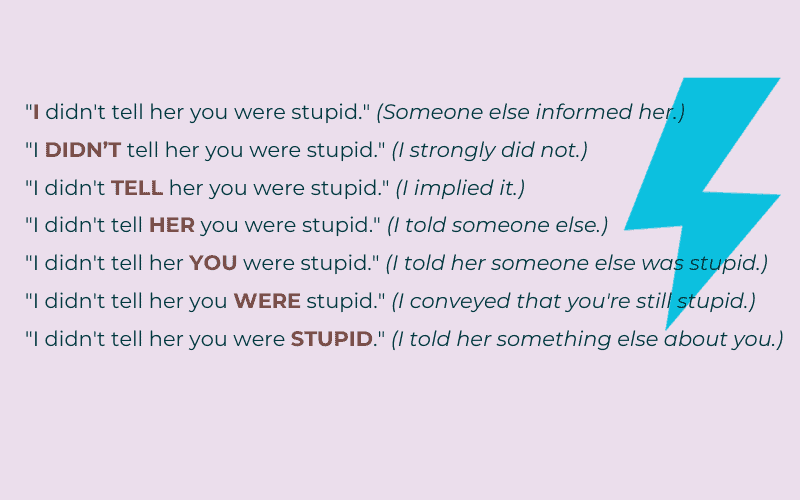
| By strategically stressing certain words, you can effectively highlight key points, convey your intentions, and ensure that your message is understood as intended. It’s a valuable tool for making your communication more precise and impactful, whether in sales or customer interactions. |
6. Vary the volume to get your customer to listen actively
Volume control is a crucial aspect of effective communication. You don’t want to be too loud or too soft; finding the right balance is key.
The art of volume adjustment:
Your voice volume should be appropriately modulated to ensure that customers can hear you clearly without feeling overwhelmed or ignored.
Speaking too quietly:
If you speak too quietly, you may come across as shy or difficult to understand. This can lead to frequent requests such as “Could you repeat that?” – not an ideal scenario when you’re trying to provide excellent customer service or effectively highlight a unique selling point of your product.
Speaking too loudly:
On the other hand, speaking too loudly can be perceived as aggressive, brash, or overbearing. It may make customers uncomfortable and less willing to engage in a productive conversation.
The key is to strike a balance where your voice is audible, clear, and pleasant to listen to. Adjust your volume according to the situation and the customer’s preferences.
| Effective volume modulation ensures that your message is heard and understood without overwhelming or underwhelming your audience, making it an essential skill for sales and customer service professionals. |

7. Use pauses to allow your customer to reflect on your words
Pauses, often underestimated, play a crucial role in facilitating better understanding and engagement in your conversations.
The power of pauses:
Pauses are not merely empty spaces in speech; they are potent tools that pique curiosity and encourage active listening. They compel your audience to want to know more and to pause themselves to truly absorb what you’re saying.
Enhancing comprehension:
By breaking your speech into smaller, digestible segments with pauses, you significantly improve speech comprehension. Your ideas are conveyed more persuasively when you give your listener the mental space to process and absorb each point.
Reflection and connection:
Pauses also grant your customer the invaluable gift of time to reflect on your words. They can start making connections between what you’re saying and their own experiences or knowledge in real-time, fostering a deeper understanding of your message.
Conveying emotion:
Interestingly, pauses can convey emotional states. For instance, several pauses before or after words may indicate that the customer is experiencing strong emotions like anger. For example, “I am… so… angry I can hardly… speak.” Pay attention to pauses, as they can provide subtle insights into the speaker’s emotions or the underlying message.
| Incorporating well-timed pauses into your communication not only enhances comprehension but also allows for a more profound connection with your customer. It provides them with the mental space to engage actively with your words and can even reveal underlying emotions that might otherwise go unnoticed. |
“No word is ever as effective as a rightly timed pause.”
– Mark Twain
8. Fine-tune your speech rate to hold your customer’s attention
The speed at which you speak can significantly impact your customer’s ability to understand and stay engaged with your conversation.
Optimal speech rate:
Speak at a pace that allows your customer to comprehend and maintain interest in your dialogue. The speed at which you communicate should match your customer’s natural listening pace.
The dangers of speaking too fast:
If you speak too rapidly, your customer might struggle to keep up mentally, and they might disengage quickly. While some parts of your message might get through, most will not. If your customer is swift with their words, having quick responses ready can help maintain their engagement.
The pitfalls of speaking too slow:
On the other hand, if you speak too slowly, your customer might find it irritating or lose interest as their mind wanders elsewhere. Balancing the pace is key to holding their attention.
Strategies to speak slower:
Focus on enunciation:
Clear enunciation forces you to pronounce each word distinctly and avoid slurring or eliding syllables. This naturally slows down your speech.
Concentrate on phrasing:
Oral communication consists of phrases and sentences, and punctuation guides the pauses. For instance, you pause briefly after a question mark, a bit longer after a comma, and the longest after a period. By focusing on phrasing, you can naturally slow down your speech and make it more comprehensible.

Strategies to speak faster:
Practice and preparation:
Thoroughly prepare and practice your content in advance. Familiarity with your material allows you to speak confidently and naturally at a faster pace.
When you’ve rehearsed your presentation thoroughly, you can speak more quickly without stumbling over your words.
Concise phrasing:
Structure your sentences for maximum efficiency. Avoiding unnecessary repetition, and getting to the point quickly enables faster communication.
Example: Instead of saying “In conclusion, I would like to say,” simply say, “In conclusion.”
| Adapting your speech rate to match your customer’s listening pace is a valuable skill. It ensures that your message is not only heard but also fully understood and engaged with. By striking the right balance, you can keep your customer’s attention and foster productive, effective communication. |
9. Articulate for a better understanding
Effective verbal communication is a fundamental skill, especially in customer service and sales roles, where conveying information clearly and being easily understood are paramount. One key aspect of achieving clarity in your communication is improving your articulation.
Why articulation matters:
Articulation refers to the clarity with which you pronounce words and sounds. It plays a critical role in ensuring that your message is comprehensible to your customers or clients. Here’s why articulation is crucial:
Clarity and understanding:
Proper articulation ensures that each word is pronounced distinctly. When you articulate well, your customers can follow your conversation with ease, reducing the likelihood of misunderstandings.
Professionalism:
Clear articulation is a sign of professionalism. It reflects your commitment to effective communication and your respect for your customers’ time and needs.
Confidence:
When you articulate your words confidently, it conveys a sense of assurance and expertise to your customers, which can be reassuring in a customer service or sales context.
Tongue Twisters for articulation practice:
Tongue twisters are fun and effective tools to improve articulation. They consist of sequences of sounds and words that are challenging to pronounce, requiring precise articulation.
Here are a few tongue twisters to get you started:
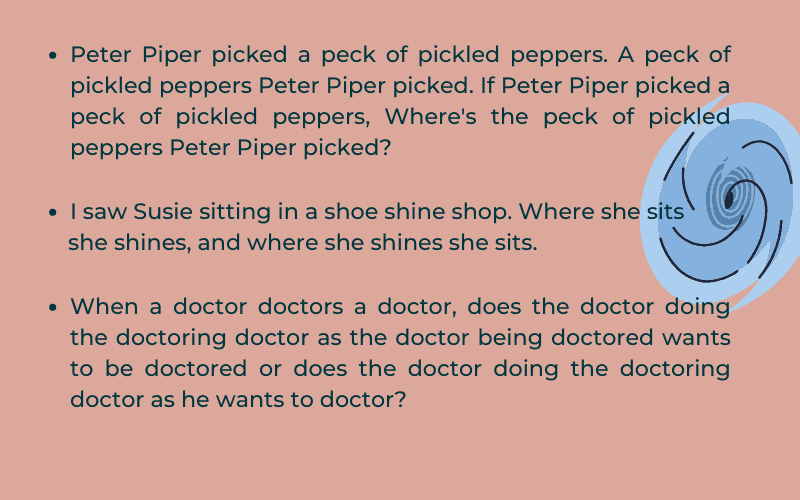
| Practicing these tongue twisters can help you improve your articulation and pronunciation, leading to clearer and more effective communication during customer service or sales interactions. |
10. Avoid filler words, sounds and phrases to sound more credible
In customer service and sales, credibility is essential. Filler words, sounds, and phrases can detract from your credibility as a speaker. They include “um,” “uh,” “ah,” and phrases like “I think that,” “you know,” and “what I’m trying to say is.” Here’s why eliminating them is crucial:
The impact of filler elements:
Weakens credibility:
Filler elements contribute nothing to your message and can weaken your effectiveness as a speaker. They may be perceived as indicators of lack of preparation, knowledge, or passion, which can erode your credibility.
Disrupts flow:
Filler elements disrupt the flow of your speech, making it harder for your audience to follow your message smoothly.
Reduces impact:
Using filler elements can dilute the impact of your words, making it less likely that your customers will take your message seriously.
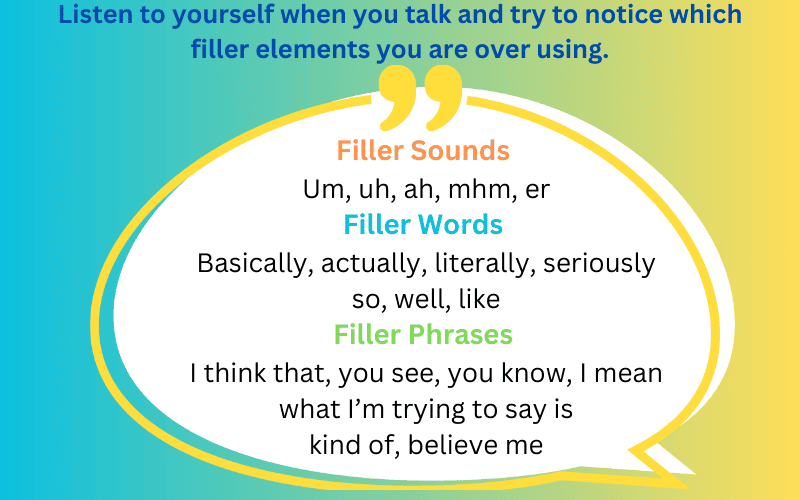
Strategies to eliminate filler elements:
Slow down:
One of the reasons people use filler elements is to give their brain extra time to process thoughts. Slowing down your speech can reduce the frequency of “um’s” and “ah’s” because your brain doesn’t feel as rushed. Even a modest reduction in your speaking pace can help.
Embrace the pause:
Instead of using filler words, replace them with brief moments of silence. While this might feel uncomfortable at first, it’s a powerful technique. Pauses can make your speech more impactful and allow your audience to absorb your message. Practice and commitment to change will help you adapt to this approach.
| By consciously working to eliminate filler elements, you’ll enhance your credibility as a speaker in customer service and sales interactions. Your message will come across as more polished, confident, and trustworthy. |
Conclusion
In the world of customer service and sales, phone interactions are the frontlines where connections are forged, deals are made, and relationships are nurtured. The power of your voice cannot be underestimated, as it serves as the bridge between you and your customers.
In this article, we’ve explored ten crucial strategies for harnessing the potential of your voice to provide better service and achieve sales success over the phone. From posture to articulation or tone, these techniques offer a comprehensive toolkit to enhance your phone communication skills.
But our journey doesn’t end here. In the next month’s article, we’ll delve deeper into the art of building rapport over the phone. Establishing a genuine connection with your customers is a fundamental aspect of fostering trust and loyalty. We’ll explore the strategies and techniques to make each interaction a positive and memorable experience.
As you embark on this journey to master the art of phone communication, remember that your voice has the power to convey emotions, build trust, and make a lasting impact. By adopting these strategies and refining your skills, you can excel in the world of phone-based customer service and sales.
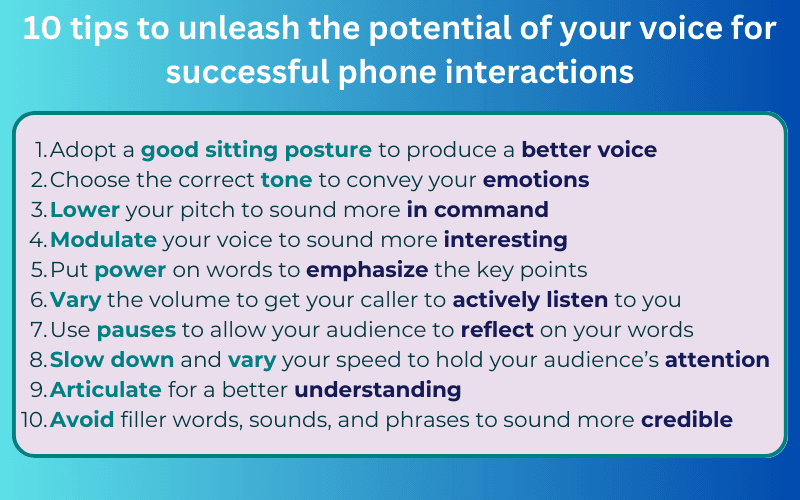
Prefer a visual? Explore the key points in this SlideShare presentation:
Ready to delegate? Explore the unique value I add to your business!
Click here to learn more about my services and how I can bring a holistic approach to your work.
 Cath Assist Service