

Welcome back to our series on mastering phone interactions. In our last article, we delved into the impactful role your voice plays in conveying emotions, building trust, and ultimately, ensuring success over the phone. We uncovered ten effective strategies for harnessing the potential of your voice to provide better service and achieve sales success over the phone.
Today, our focus shifts to the crucial art of establishing rapport over the phone.
Rapport isn’t about making best friends; it’s about creating a comfortable space for free and easy communication. Lack of rapport can significantly impact the outcome of any conversation.
First impression lasts
As the saying goes, “You never get a second chance to make a first impression.” Within the first few seconds of a call, the caller forms an impression of you that can shape the future relationship. Your tone and initial responses play a pivotal role in creating this impression.
Answering with the right tone and asking appropriate questions not only reflects positively on you as an individual but also on the organization you represent. A positive first impression sets the stage for efficient and confident call handling.
The distancing factor
The telephone introduces a unique challenge – the distancing factor. Without the visual cues of a face-to-face interaction, some callers may feel empowered to be more abrasive. The psychological effect of the telephone can dehumanize the interaction, making it easy to forget that you are dealing with a real person with feelings.
Navigating these initial challenges is crucial and involves aligning yourself with the caller.
Beyond the initial impression and the challenge posed by the distancing factor, building rapport becomes essential. Establishing a connection that transcends the limitations of the telephone is an art that involves employing specific strategies.
Let’s delve into ten effective approaches to foster positive and memorable interactions.

1. Make the caller feel welcome
1) Creating a welcoming atmosphere sets the stage for positive interactions
Before answering the phone, adjust your posture by sitting straight and leaning slightly forward. This not only contributes to a richer tone but also boosts your confidence.
Taking deep breaths will make you sound more alert and convey your enthusiasm that the customer has called. This practice enhances the clarity of your voice, projecting confidence and alertness, ultimately fostering more productive conversations.
Moreover, it helps reduce tension, keeps you focused, calm, and relaxed.
2) Remember to open the call with a smile!
A smile can be heard and a ‘smiling voice’ is more welcoming and relaxing. Your caller will feel appreciated and subconsciously form a positive impression of you.

2. Visualize the caller
Shift your perspective – the voice on the other end is a real person!
Create a mental image of your caller to remind yourself that you’re connecting with another human being. This helps establish a more personal and meaningful connection.
Imagine their expressions and verbal responses, putting in extra effort to make them feel welcome and valued.

3. Mirror the caller
Harness the power of similarity
Building rapport is often about finding common ground. People tend to like those who are similar to themselves. The technique of mirroring, or “reflectioning,” is based on this psychological principle. Subtly imitate the voice qualities of the person at the other end of the line, matching their pace, tone, and even the choice of words.
This technique, when executed seamlessly, puts the caller at ease and establishes a sense of trust.
Which elements to mirror:
- Mirror their pace: If the caller speaks quickly, adjust your pace accordingly. People appreciate what’s familiar, and matching their speed builds a sense of connection.
- Mirror their tone: Listen to how the caller speaks and adapt your tone to match. If they have a regional accent, subtly adjust your pronunciation to create a sense of familiarity.
- Mirror their use of words: Pay attention to the words and phrases the caller uses, and incorporate similar language into your responses. This helps establish a sense of shared understanding.

The key to effective mirroring is subtlety. The goal is to communicate on an unconscious level that you’re not a threat but a potential friend and ally.
“Rapport is the ability to enter someone else’s world, to make him feel that you understand him, that you have a strong common bond.”
Tony Robbins
4. Listen actively
1) Active listening is a cornerstone of rapport building
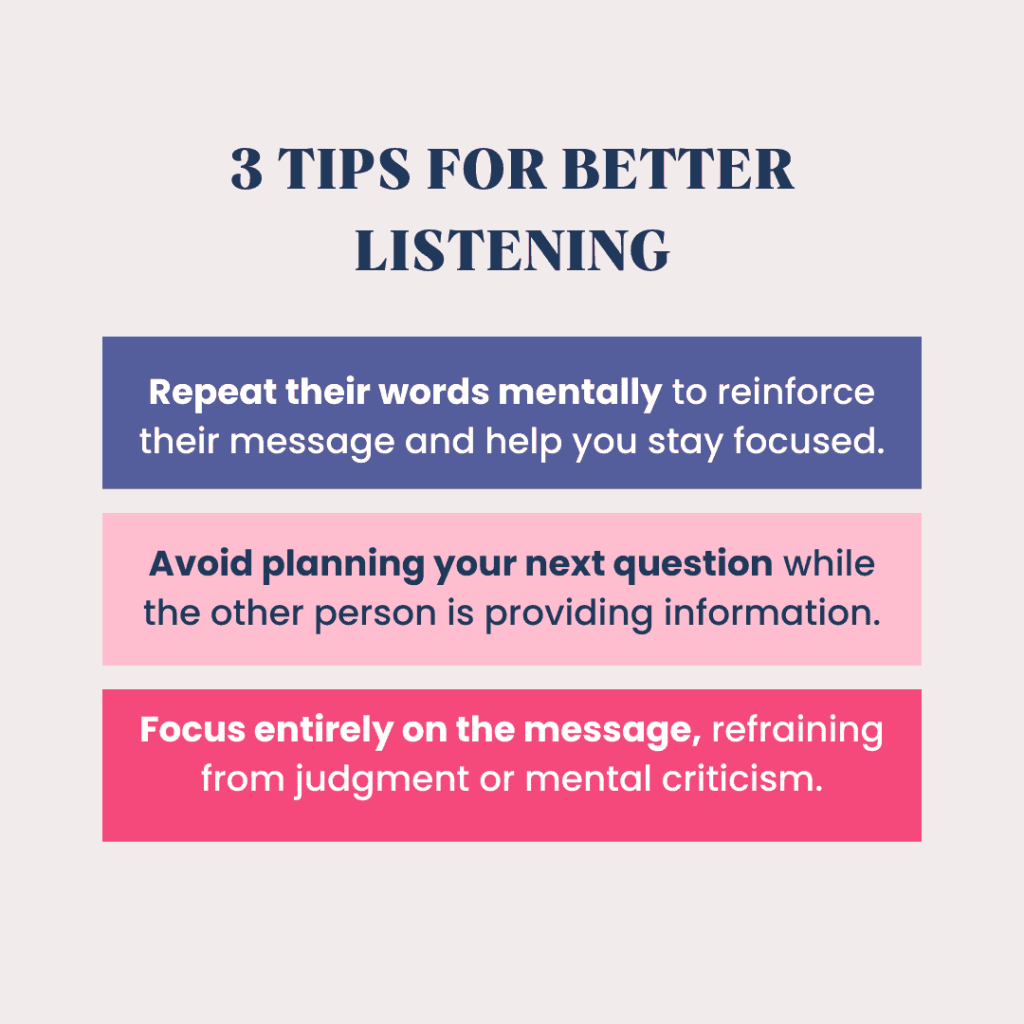
Active listening is an art, especially challenging over the phone where visual cues are limited.
To maintain concentration, eliminate visual distractions:
- Silence computer notifications: The constant ping of incoming emails can be a significant distraction. Turn off notifications to stay focused on the conversation.
- Minimize phone notifications: Buzzing phones can disrupt your concentration. Mute unnecessary alerts to ensure a more focused and attentive listening experience.
- Stay still when listening: Avoid fidgeting or constantly changing your seating position. Your caller will appreciate your undivided attention.

2) Pay attention to what is said, how it is said and to what is not said
Listen attentively not only to the spoken words but also to how they are conveyed. Pay close attention to the tone, pacing, and emotions embedded in the words.
Effective listening involves going beyond the literal words and tuning into the unspoken cues.
| Listening in this way allows you to grasp the full spectrum of the caller’s feelings and thoughts. |
3) Let your caller know that you are listening
Use supportive noises and connecting words to signal and demonstrate your active engagement in the conversation.
Respond with gentle ‘ums’ and ‘ahs,’ along with affirming phrases like “OK,” “yeah,” or “I get it.”
These verbal cues serve multiple purposes:
- Express understanding: Affirmative responses like “OK” or “I get it” show that you are following the caller’s message and comprehending their points.
- Maintain flow: Using gentle noises like “um” or “ah” can fill pauses without interrupting the caller, indicating that you’re still attentive and processing the information.
- Provide emotional support: These verbal cues can convey empathy and support, making the caller feel heard and understood.
- Build rapport: By affirming the caller’s words, you create a positive atmosphere, fostering a sense of connection and trust in the conversation.
5. Don’t interrupt to impose your solution
As the saying goes, “The biggest communication problem is that we don’t listen to understand but listen to reply.“
1) Resist the urge to interrupt!
Employ these strategies to establish a genuine connection:
- Allow the caller to finish each point: Interrupting is a waste of time and limits full understanding of the message. Interrupting at the wrong time can cause the caller to feel like they need to repeat themselves, which will only lengthen your call time.
- Don’t jump to conclusions: Finishing their sentences shows that you’ve been thinking of what you want to say while they are still talking.
- Remain focused: Tune in to what the caller is trying to put across. Hear everything that is said, not just the parts that you agree with!
- Share their priorities : Every caller will have a list of priorities. Make them also your priorities. Address them in the right order (mirroring them) to reassure your caller that you know what they want and that you are taking care of them.

2) Handling Talkative Callers
Interrupting a talkative caller is not always recommended, as it can be perceived as rude or impolite.
However, in certain situations, strategic interruptions may be necessary to:
- Regain control of the conversation: If a caller is providing excessive or irrelevant information, interrupting can help you guide the conversation back to the main topic or address their needs more efficiently.
- Maintain efficiency: In a customer service setting, where time is often a factor, interruptions may be necessary to ensure that the conversation stays within a reasonable timeframe while still addressing the caller’s concerns.
- Ensure clarity: Strategic interruptions can be used to seek clarification on specific points or to prevent misunderstandings, ensuring that both parties are on the same page.
Here are some techniques to manage talkative callers effectively:
- Use the caller’s name:
Politely interrupt by addressing the caller using their name.
[“Caller’s Name], I appreciate your input and I’d like to address your concerns step by step.” - Signal engagement with pauses:
Insert well-timed pauses to signal that you are actively listening and engaged in the conversation. This can encourage the caller to pause as well, creating opportunities for a more balanced exchange. - Express agreement or understanding:
Introduce interruptions by expressing agreement or understanding with the caller’s points.
“I understand your perspective, and I’d like to ensure we cover all aspects of your concern.” - Paraphrase key points:
Instead of abruptly interrupting, paraphrasing involves summarizing the essential elements of what the caller has said. By restating their key points, you demonstrate understanding while gently guiding the conversation in a more focused direction.
“If I understand correctly, you’re concerned about [summary of key points]. Is that accurate?” - Provide subtle guidance:
Offer gentle suggestions or guidance to nudge the conversation toward a specific aspect or topic. This helps maintain a constructive and purposeful dialogue without coming across as dismissive.
“I appreciate your thorough explanation. To ensure we address your concerns effectively, could we now focus on [specific aspect]?” - Pose clear and direct questions:
Rather than interrupting, ask questions that prompt concise responses and steer the conversation in a focused direction.
“To better assist you, can you share more details about [specific aspect]?”
| These strategies aim to strike a balance between active engagement and maintaining a productive conversation, even in situations where interruptions are necessary. |
6. Repeat back to show interest
Active listening goes beyond merely hearing words.
1) Prove your engagement by repeating back what you’ve heard
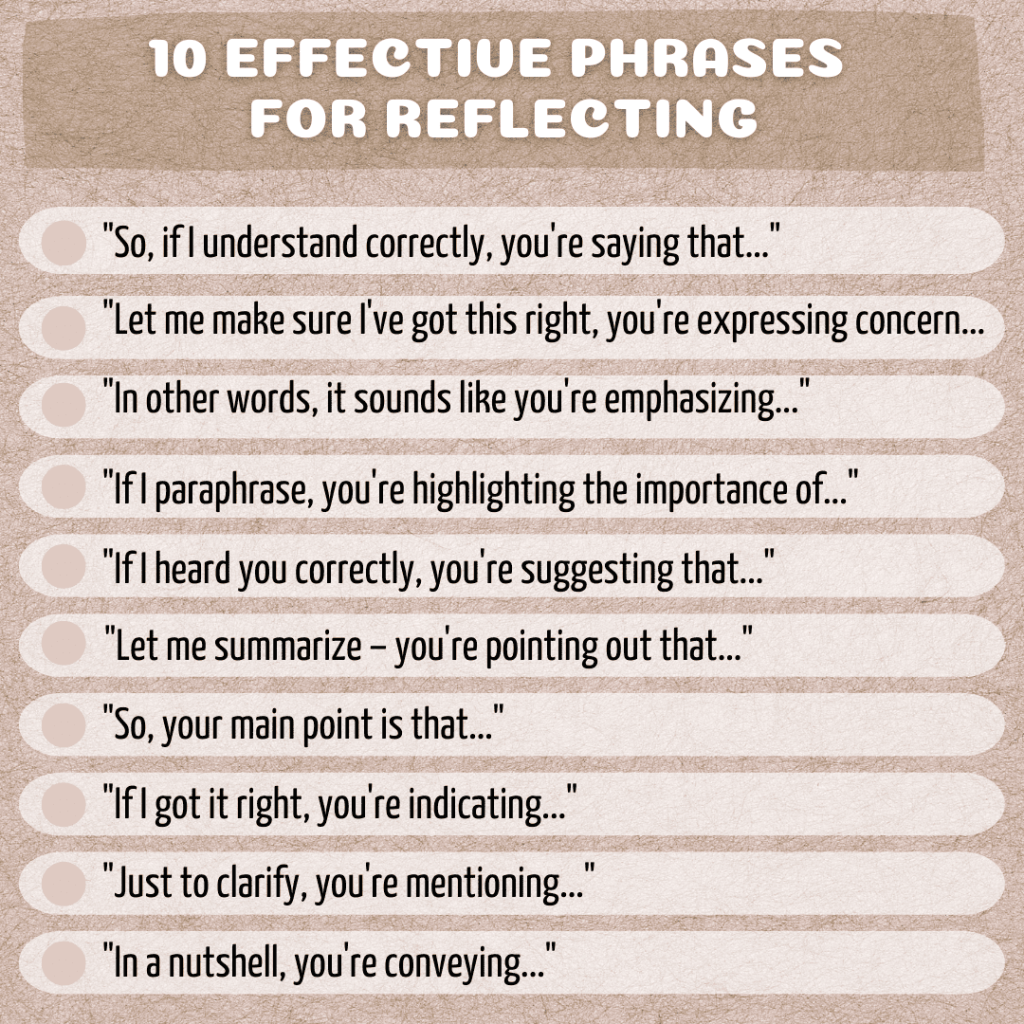
When you repeat back, you’re essentially paraphrasing what the other person has said. This involves expressing their message using your own words while preserving the intended meaning.
The purpose is to convey your understanding of the message back to the caller. By doing so, you confirm that you’ve grasped the content and are actively engaged in the conversation.

2) Benefits of reflecting:
- Clarification of understanding: By repeating back, you create an opportunity to verify that your interpretation aligns with the caller’s intended message. This helps prevent misunderstandings.
- Feedback for the caller: The act of reflecting provides the caller with feedback on how their message is being received. It allows them to gauge whether their communication is clear and effectively conveyed.
- Demonstration of interest and respect: Reflecting back the message shows that you are genuinely interested in what the other person is saying. It’s a demonstration of respect for their perspective and a commitment to understanding their viewpoint. It shows that you are making an effort to understand their thoughts and feelings.
7. Establish an emotional connection through empathy
When handling complaints, it’s common to jump into information gathering. You would be asking them for their name, invoice number, date of purchase, and perhaps a half dozen other questions.
The problem with this approach is it sounds like an interview or worse, an interrogation.
1) Taking a moment to express genuine empathy can significantly improve the customer experience
Empathy is the art of understanding and acknowledging a caller’s feelings and needs, before finding a solution that meets them.
It‘s a great way of building rapport, because the customer feels understood and cared about.

2) Building rapport through empathy involves:
- Put yourself in the caller’ shoes: Imagine the impact the problem has on their day. If struggling to display empathy, envision them as a close friend or family member.
- Take a personal interest: If a caller mentions a personal detail, such as being in the hospital, ask about their recovery.
- Remain neutral and offer constructive answers: Before jumping into problem-solving, acknowledge the caller’s concerns through genuine empathy. They need to feel that you have really „heard“ them.
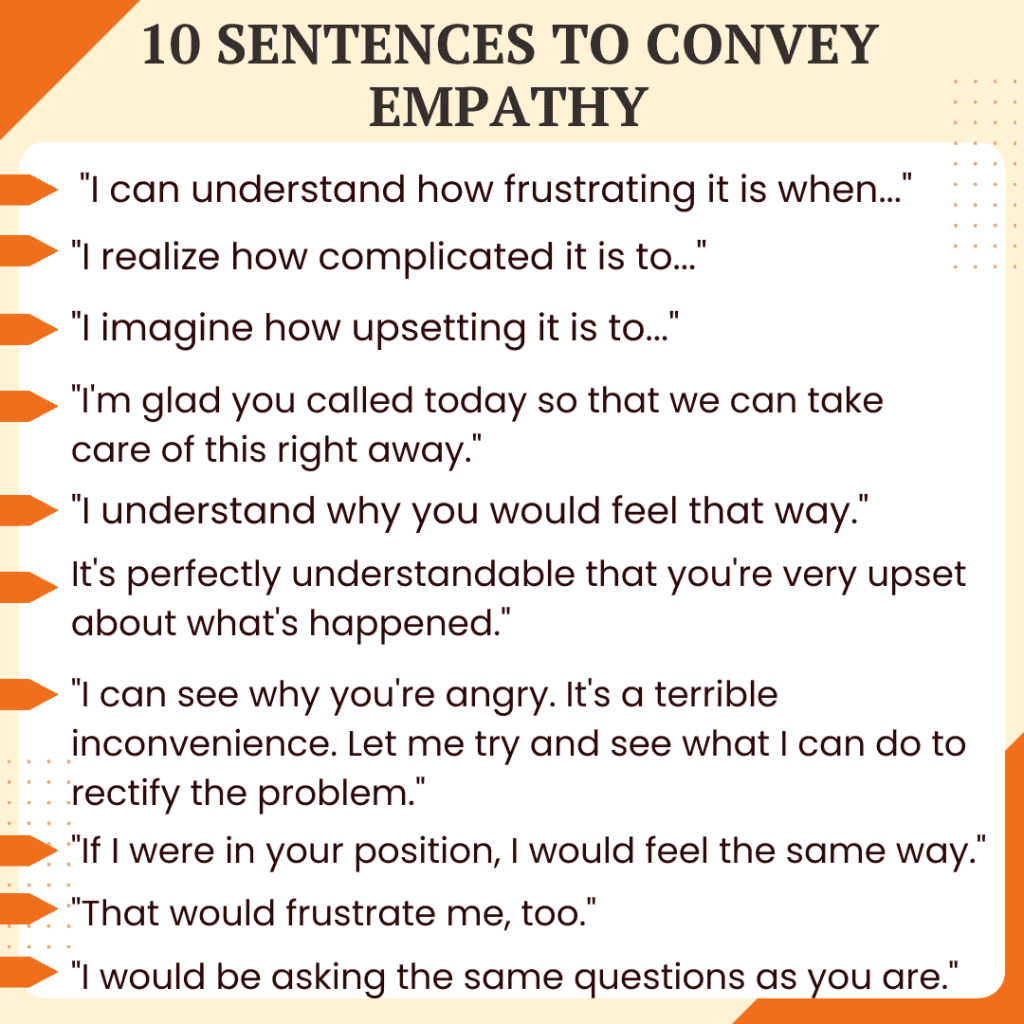
| Remember, the right tone of voice is crucial in conveying genuine empathy! |
“People don’t care how much you know until they know how much you care.”
Theodore Roosevelt
8. Ask questions to guide, understand and retrieve data
1) Take the lead in the conversation by asking questions
Asking questions helps you gather essential information about the caller, allowing you to comprehend their specific needs, challenges, and problems. This understanding is foundational to providing effective assistance.
By delving into the caller’s wants and needs, you gain insights that enable you to tailor your assistance to meet their specific requirements. This personalized approach enhances the likelihood of a successful resolution.
The act of asking questions signals to the caller that you are genuinely interested in their concerns. This demonstrates that you are not just focused on completing a transaction but are invested in ensuring the caller’s needs are addressed comprehensively.

2) The Funnel Technique for successful phone interactions
For successful phone interactions, it is essential to employ various types of questions at different stages of the call.
The different types of questions are used in a structured approach called the funnel technique.
This method begins with open-ended questions to gather a comprehensive understanding of the caller’s situation. It then progressively narrows down to more specific inquiries, fostering a detailed understanding, facilitating efficient problem-solving and ensuring a smooth and customer-centric communication flow.
Here are the six types of questions used to guide the conversation effectively and for optimal impact:
Open Questions (W- Questions):
- Begin with broad inquiries to comprehensively understand the caller’s situation, needs, and preferences. This encourages the caller to express themselves freely, fostering openness.
- “How can I help you?” or “What is the call regarding?”
Closed Questions (Yes or No Questions):
- Transition from open-ended questions to more specific ones, allowing for a smoother flow in the conversation. These questions help gather focused information and make decisions efficiently.
- “Are you already a customer?”
Counter Questions:
- Provide background information, prevent the need to excuse or justify, enhance confidence, buy time, and direct the conversation toward the caller’s needs. These questions are strategically used as needed during the conversation.
- “It’s hard to say when Mr. Robert’s appointment will finish. When are you best available?”
Pointed/Specific Questions:
- Elicit detailed responses, command the conversation’s direction, and add value to the interaction. Deploy these questions when more specific information is required.
- Instead of “Can I take your phone number so that my colleague can call you back?” ask, “On which phone number can my colleague call you back?“
- Instead of “Can I leave him a message?” ask, “What is your message for him?”
Control Questions:
- Ensure a clear understanding of the situation by periodically checking the caller’s perspective. This ongoing confirmation contributes to a more accurate and helpful interaction.
- “Have I understood you correctly, he can reach you late afternoon today?” or “Then I’ll let Mr. Smith know that…”
Alternate Questions:
- Offer choices to the caller, promoting a customer-centric approach. These questions are particularly useful when providing options is necessary.
- “Do you prefer an appointment on Wednesday at 10:30 or Thursday at 15:00?”
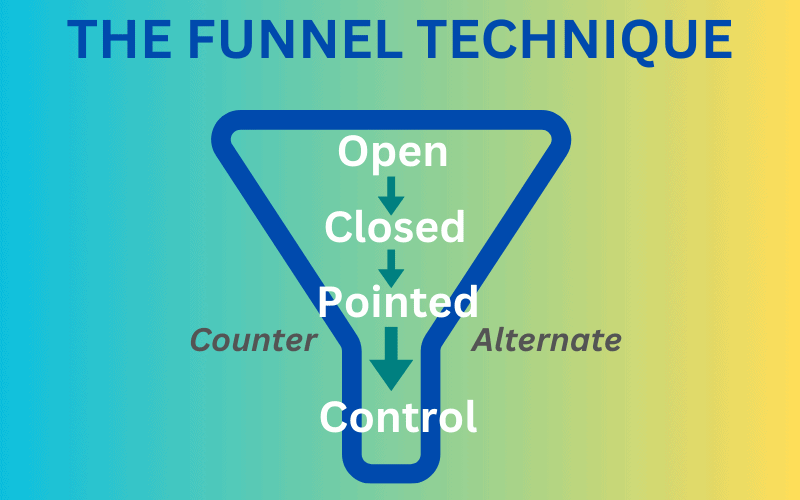
| The funnel technique’s systematic progression from broad to specific questions optimizes communication flow, builds trust, and facilitates problem-solving, contributing to the overall success of phone interactions. |
9. Choose the right words
The way you choose your words significantly influences communication outcomes. The words you select can shape how your message is perceived, understood, and received by the caller.
Explore these strategies to craft words that foster rapport, convey empathy, and enhance phone interactions:
1) Optimize communication with positive language
Hearing positive words stimulates activity in the frontal lobes of the brain, promoting cognitive function. This neurological response enhances the cognitive processes involved in communication and contributes to a more positive and receptive mindset.
Speak about what you can do, not what you can’t.
Negative language triggers the release of stress-inducing hormones in both the speaker and the listener, elevating anxiety and reducing communication effectiveness. These chemicals impede cognitive functions, hindering proper reasoning and logical acceptance. A single negative word can activate the amygdala, the brain region associated with fear, initiating the release of stress hormones that disturb overall brain function.
Avoid negative language containing words like ‘not,’ ‘never,’ ‘can’t,’ as it triggers stress hormones.

2) Choose words that convey positive emotions
Words make people feel emotions. The choice of words plays a crucial role in evoking positive emotions and building rapport.
The words and expressions you use in your communication with callers have the power to influence how they feel and perceive the interaction as a whole.
How to convey specific emotions by carefully choosing your words:
Agreement and positivity:
- “Absolutely, I’d be happy to assist you with that today.”
- Starting a phrase with a word ending in -ly, such as absolutely, definitely or certainly, implies that you are agreeing with the caller and can therefore boost rapport.
Enthusiasm and Willingness:
- “I’m thrilled to guide you through this process and resolve any issues you might be facing.”
- The use of “thrilled”, “delighted” or “happy” conveys enthusiasm and a positive attitude, creating a delightful mood.
Assurance and Confidence:
- “Rest assured, I have the expertise to handle this matter for you.”
- The phrase “rest assured” communicates confidence and reassures the caller that their concerns are in capable hands.
Empathy and Understanding:
- “I understand this has been inconvenient for you, and I genuinely want to make it right.”
- Expressing understanding and acknowledging inconvenience shows empathy, addressing the caller’s concerns.
Appreciation and Openness:
- “Thank you for bringing this to our attention. Your feedback is invaluable in helping us improve.”
- Expressing gratitude for feedback shows openness to improvement and appreciation for the caller’s input.
Collaboration and Inclusivity:
- “Let’s work together to find the best solution for you.”
- Using phrases like “Let’s work together” or “we” involves the caller and fosters a collaborative atmosphere, enhancing the relationship.
Support and Availability:
- “I’m here for you, and I’ll do my best to address this promptly.”
- Assuring the caller of immediate attention conveys a sense of support and responsiveness.
| In summary, it’s crucial to be intentional with language to create a positive, empathetic, and effective customer experience. The words you choose not only convey information but also play a crucial role in shaping the emotional tone of the interaction, influencing how callers perceive the company or service. |

3) Don’t unintentionally negate what you are about to say
When you negate what you’re about to say, you introduce doubt or a lack of conviction. This can affect how your message is perceived by others. It’s crucial to communicate with confidence and clarity to ensure that the caller understands and trusts the information you’re providing.
Here are some expressions of uncertainty that can unintentionally diminish the impact and credibility of your message:
Use of conditional:
- “I could ask him to call you back. I suppose he might have the answer to your question.”
- The use of conditional and uncertainty introduces doubt in the caller’s mind, making you lose credibility and believability.
Instead say: ‘I am going to ask him to call you back. I am sure he will have the answer to your question.’
Use of “Try” and “Maybe”:
- “I‘ll try to find an answer to your question. Maybe, you‘ll get it.”
- ‘Try and maybe’ imply that you are unreliable, lacking motivation, and that you will not do what you say you will do.
Instead say: ‘I will find an answer to your question. You will get it as soon as possible.’
Use of “Just”:
- “I am just the secretary/assistant. My manager will have the answer to your question.”
- ‘Just’ implies that your ability to help the caller is limited.
Instead say: ‘I am his secretary/assistant, so I will ask my manager to answer your question.’
Use of uncertain phrases:
- “I think we are closed on Saturdays. But I could be wrong. I don‘t want to mislead you.”
- These expressions can give the impression that you are uncertain about your own communication, potentially undermining the clarity and confidence of the message.
Instead say: “My manager will confirm if he’s available Saturday.’” - “I know it‘s hard to explain….This probably isn‘t the best way to say this, but…. Maybe my wording is incorrect, but….”
- Using uncertain phrases shows a lack of belief in yourself and what you are saying, making yourself less persuasive.
Instead say: “I will make it simple. I will be as clear as possible. To simplify…”
| By avoiding unintentional negation and choosing more assertive and confident language, you enhance the effectiveness of your communication, maintain credibility, and contribute to a more persuasive and impactful message. |
4) Don’t overuse intensifiers
Intensifiers, when used appropriately and in moderation, can add emphasis and clarity to your communication. However, when overused, they can dilute the impact of your message and make it sound less credible.
Excessively using intensifiers such as ‘really,’ ‘very,’ or ‘a lot’ in your communication can have a negative impact on the effectiveness of your message, weaken your statements, and reduce credibility.
Good Use of Intensifier:
- “He’s quite busy at the moment, handling multiple important tasks. I expect him to be available later in the day.”
- In this example, the intensifier “quite” adds emphasis to the degree of busyness without being excessive. It enhances the description without diminishing the credibility of the statement.
Potentially problematic use of intensifier:
- “He’s really, really busy right now. He has a ton of appointments and a whole bunch of tasks to complete.”
- In this case, the excessive use of intensifiers like “really,” “ton,” and “whole bunch” can make the statement sound less precise and may weaken its impact. It could be improved by using fewer intensifiers for a more straightforward and credible expression: “He’s busy right now, handling appointments and tasks. He will get back to you as soon as he’s done.”
| By minimizing the use of intensifiers, your message remains clear and maintains a higher level of credibility, enhancing its overall impact. |
5) Drop bad habits to improve your communication
To enhance your communication, it’s recommended to lose certain bad habits that can all hinder effective expression, such as:
Ready-made formulas:
- Using generic phrases can make customers feel undervalued or like they are receiving scripted responses, reducing the personal touch in customer interactions.
- Example : “Thank you for calling. Your satisfaction is our top priority, and we appreciate your patience. We are here to assist you.”
Improved Approach: “Thank you for reaching out. How may I assist you today?”
Periphrases:
- Customers often seek clear and concise information. Overly complex or verbose language can lead to confusion and frustration.
- Example: “I’d like to discuss the unforeseen circumstances that have impacted the expected timeline for the resolution of your concern.”
Improved Approach: “Let’s talk about the issues that have impacted the resolution timeframe”
Familiar language:
- While friendliness is essential, using overly casual or familiar language may be perceived as unprofessional in customer service or other professional interactions.
- Example: “Hey there! Your account is kind of messed up, but don’t worry; we’ll figure it out, okay?”
Improved Approach: “Hello! I noticed an issue with your account. Let’s work together to resolve it, shall we?”
Personal opinions:
- Customer service or sales should rely on facts and solutions rather than personal opinions, which can be subjective and may not address the customer’s needs effectively.
- Example :”I believe our service is the best in the industry. You can trust us completely.”
Improved Approach: “We strive to provide excellent service. Let me share some details about what sets us apart.”
| In summary, these bad habits hinder your communication by diminishing clarity, personalization, professionalism, and persuasive power. Adopting more direct, clear, and evidence-based communication practices can help overcome these challenges. |
6) Specific strategies for handling angry callers
When dealing with upset or angry callers, it’s important to choose sentences that convey empathy, assurance, and a commitment to resolving the issue.

Here are 10 strategies you can use to navigate anger or frustration in customer interactions:
- Recognize the caller’s emotions:
- “I completely understand why this situation is frustrating for you. I want to assure you that we take your concerns seriously.”
- This sentence addresses and recognizes the caller’s frustration, assuring them that their concerns are taken seriously.
- Acknowledge the caller’s issue:
- “I recognize the problem you’re facing, and I’m here to help you navigate through it. Let’s work together to find a solution.”
- By recognizing the problem, this sentence communicates a proactive stance, indicating a willingness to work together to address the issue.
- Provide Assurance:
- “I want to assure you that resolving this matter is a top priority. I’ll personally ensure it’s addressed to your satisfaction.”
- Providing assurance emphasizes the commitment to resolving the matter promptly. The personal commitment adds a touch of sincerity and responsibility.
- Use positive affirmation:
- “I absolutely agree that this situation needs attention. I’m committed to finding a solution that works for you.”
- Affirming agreement and commitment using positive language helps align with the caller’s concerns, reinforcing dedication to finding a solution.
- Use problem-solving language:
- “Let’s work together to identify the root cause. I’ll investigate and provide you with a solution to prevent this from happening again.”
- This sentence adopts a proactive approach, emphasizing collaboration and a commitment to preventing a recurrence by identifying and addressing the root cause.
- Reiterate assistance:
- “Thank you for your patience. Rest assured, I’m here to assist you through this, and together, we’ll find a resolution.”
- Expressing gratitude for the caller’s patience and restating the commitment to assistance reinforces a positive and supportive interaction.
- Express empathy and commitment:
- “I can imagine how frustrating this must be for you. I’m here to help and will do everything within my capability to address your concerns.”
- The sentence acknowledges the caller’s frustration with empathy, offering assurance that you are ready to help and understand their concerns.
- Apologize for the inconvenience and outline next steps:
- “I want to sincerely apologize for any inconvenience. Let’s discuss what happened, and I’ll outline the steps we’ll take to make things right.”
- By offering a sincere apology, this sentence acknowledges any inconvenience and sets the stage for discussing the situation and outlining the steps for resolution.
- Assure follow-Up:
- “I understand the problem, and I will follow up on this for you. You have my commitment that we’ll get to the bottom of it.”
- This sentence not only expresses understanding but also assures the caller that their concerns will be actively addressed, instilling confidence in a follow-up.
- Propose a collaborative approach:
- “I appreciate you bringing this to our attention. Let’s collaborate to find the best resolution. Your input is valuable in helping us improve.”
- Expressing appreciation for the caller’s input and proposing collaboration emphasizes a customer-centric approach, indicating a willingness to work together for a resolution.
| The language used is aimed at de-escalating the situation, creating a positive interaction, and assuring the caller that their concerns are being taken seriously and will be addressed effectively. |
“Speak in such a way that others love to listen to you. Listen in such a way that others love to speak to you.”
Zig Ziglar
10. Summarize and close the conversation
The way a communication is closed plays a crucial role in shaping how the conversation is remembered. The final 30 seconds are pivotal, as they significantly influence the customer’s opinion of your service or your company.
Conclude calls successfully: 5 Steps for a lasting positive impact
1. Provide a comprehensive summary:
- Begin by summarizing the key points of the conversation, ensuring the caller’s needs are accurately captured. Encourage the caller to review and confirm these points for clarity.
- Example: “Before we conclude, let me summarize our discussion. We’ve addressed your concerns regarding [specific issue], explored solutions, and confirmed your preferences for [resolution]. Does that align with your understanding, or is there anything you’d like to revisit?”
2. Discuss next steps:
- Guide the caller through specific actions that follow the call, such as sending an email summary, providing additional information, or scheduling further assistance.
- Example: “Looking ahead, our next steps involve [specific actions]. I’ll send you an email with a summary and the details we discussed today. If you have any questions after our call, feel free to reply to that email.”
3. End on a positive and grateful note:
- Concluding the conversation on a positive note is essential. Express gratitude and appreciation, reinforcing a positive impression of the interaction.
- Always thank the customer for calling. This simple expression of gratitude goes a long way in leaving a positive impact on the customer’s perception of the service provided.
- Example: “Thank you for sharing your concerns with us today. We appreciate your time and the opportunity to assist you.
4. Offer further assistance:
- Before ending the call, inquire if there is anything else you can do for them. This demonstrates that your priority is not just concluding the call but ensuring that the caller’s needs have been fully addressed. It emphasizes a commitment to providing excellent service.
- Example: “Before we wrap up, is there anything else I can assist you with? Our goal is to ensure you’re completely satisfied with our service, and I’m here to help with any additional questions or concerns.”
5. Confirm agreement and close the call:
- Reiterate key points, ensuring mutual understanding, and provide assurance that the matter has been addressed. Close the conversation with a clear acknowledgment.
- Example: “To ensure we’re on the same page, we’ve covered [key points]. If everything aligns with your expectations, we’ll consider this matter addressed. Thank you once again for reaching out.”
| In essence, the summarization and closure phase is an opportunity to leave a lasting positive impression. It ensures clarity, expresses gratitude, and reinforces a customer-centric approach, contributing to a memorable and satisfying customer experience. |

Conclusion
Mastering phone interactions is an art that requires a combination of emotional intelligence and a step-by-step process. In the first part of our series, we explored the pivotal role of voice, delving into strategies to harness its power for successful conversations. Building on this foundation, the second part delved into the art of establishing rapport, emphasizing the importance of overcoming the distancing factor, and employing ten effective approaches for positive interactions.
From creating a positive first impression to handling talkative callers, active listening, empathy, and asking the right questions, each strategy contributes to successful conversations. Handling angry callers with empathy and closing with a comprehensive summary are crucial steps for a positive lasting impact.
In essence, mastering phone interactions goes beyond spoken words; it involves skillfully orchestrating various elements for effective communication.
By integrating these strategies, you empower yourself to navigate diverse scenarios, building meaningful connections and ensuring successful outcomes over the phone.
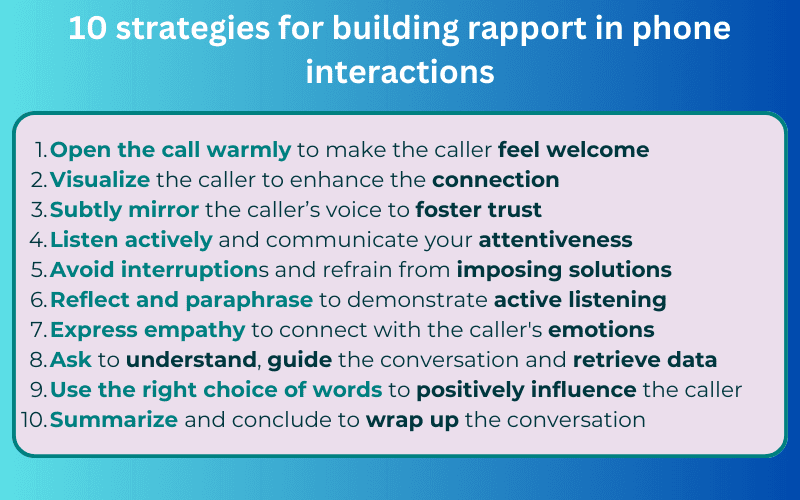
Prefer a visual? Explore the key points in this SlideShare presentation:
Ready to delegate? Explore the unique value I add to your business!
Click here to learn more about my services and how I can bring a holistic approach to your work.
 Cath Assist Service