

In a world that tends to praise busyness, it’s essential to pause and reflect on whether your workload is translating into genuine efficiency. Are you really getting things done, or are you simply juggling tasks without achieving tangible results?
In the hectic pace of everyday life, it’s easy to get caught up in tasks and responsibilities. However, being busy isn’t always synonymous with efficiency; busyness can be like a disease in disguise, hindering real efficiency and preventing both your business and your life from thriving.
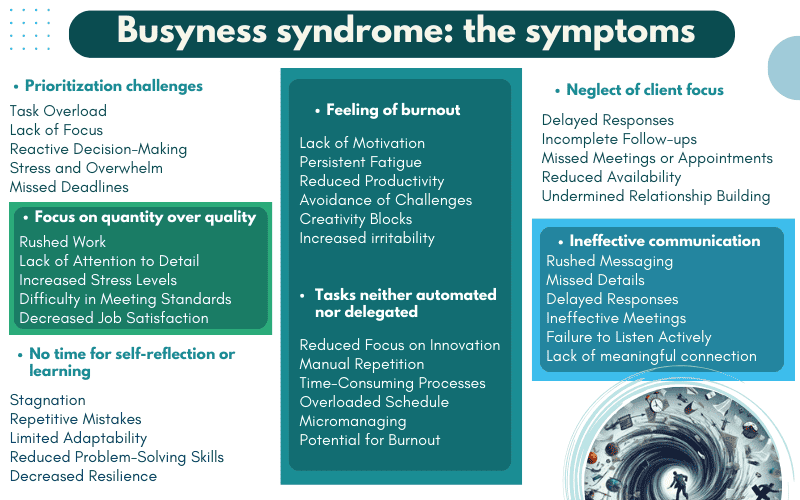
In this blog, we’ll diagnose whether you’re affected by this busyness syndrome, revealing its common symptoms. In our next article, we’ll explore strategies for overcoming this syndrome and fostering a more balanced and fulfilling life. Stay tuned for practical advice on how to restore efficiency and well-being!
It’s time to unmask the symptoms of busyness syndrome that are silently undermining your efficiency and well-being!
As you explore each of these symptoms, ask yourself which ones resonate with your experiences.

1. Do you suffer from prioritization challenges?
Juggling tasks may seem like progress, but without proper prioritization, you run the risk of losing focus on critical activities.
Without effective prioritization, you may find yourself constantly multitasking without devoting the necessary attention to essential, goal-oriented activities.
Instead of acting intentionally, you risk making reactive decisions and dealing with tasks as they arise, rather than approaching your workload strategically.
Moreover, a lack of prioritization can lead to stress and feelings of being overwhelmed as you struggle to manage an ever-growing list of tasks without knowing exactly which ones are really important.
Finally, without a systematic approach to prioritization, you risk missing deadlines or tackling them haphazardly, leading you into a cycle of catch-up.
| Recognizing these behaviors is the first step toward addressing the symptom of challenges in prioritization, as it empowers you to implement strategies for effective prioritization, transforming patterns into a more intentional and efficient approach to daily tasks. |

2. Do you tend to focus on quantity over quality?
In a perpetually busy environment, there’s often a sense of urgency to complete tasks quickly.
The pressure to produce more tasks can lead you to rush through your work and overlook important details. You may prioritize the rapid completion of tasks rather than the thorough examination of every aspect.
Balancing the demands of quantity and quality can increase your stress levels, especially when the pressure to produce a large volume of work conflicts with the need to pay meticulous attention to quality.
Moreover, if you’re focused on quantity, you may find it challenging to meet industry standards or conform to quality criteria, which could damage your work’s overall reputation and credibility.
Finally, the constant pursuit of quantity without regard for quality can diminish your job satisfaction over time, especially if your work lacks meaningful impact or excellence.
| Recognizing these behaviors is crucial for addressing the symptom of the quantity versus quality focus, as it empowers you to implement strategies for effective balance, fostering a more sustainable and fulfilling work approach. |

3. Do you experience the feeling of burnout?
Burnout is a state of physical, emotional, and mental exhaustion resulting from prolonged stress and overwork.
Burnout can lead to a drop in motivation, making it difficult to find inspiration or enthusiasm for your work.
Feeling constantly exhausted can have an impact on your ability to be creative and solve problems in innovative ways, creating mental blocks and stifling your ability to generate new ideas.
Burnout often leads to lower productivity, as the mental and physical burden of exhaustion makes it more difficult to complete tasks efficiently. It can also lead you to avoid difficult tasks or projects, as mental fatigue can make them seem overwhelming and insurmountable.
In addition, physical symptoms such as headaches or sleep disorders can indicate burnout. If you feel constantly overwhelmed, irritated, and emotionally drained and have trouble recovering after a day’s work, these could be indicators of burnout.
| Recognizing these behaviors is crucial for addressing the symptom of burnout, as it empowers you to take proactive steps to foster a healthier work-life balance and prevent further deterioration of your well-being. |

4. Do you find yourself not having time for self-reflection or learning?
Taking the time to evaluate processes and learn is essential for long-term success.
Without time for self-reflection, you may feel that you’re not progressing personally as well as professionally and that you’re stagnating in your skills and knowledge.
Without taking the time to reflect on your past experiences, you tend to repeat mistakes, as lessons learned can go unnoticed, affecting the quality of your work and your efficiency.
If you don’t have the time to learn, it can reduce your ability to adapt to changing work environments and evolving industry trends, which can prevent you from staying relevant and competitive. In turn, a lack of self-reflection can contribute to diminished problem-solving skills, since critical thinking and analytical abilities benefit from in-depth reflection on past experiences.
Finally, in the absence of self-reflection, you may be less resilient in the face of challenges. Regular introspection helps to build resilience by fostering a better understanding of your strengths and areas for improvement.
| Recognizing these behaviors is crucial for overcoming the symptom of a lack of time for self-reflection and learning, as it empowers you to break free from the cycle of stagnation, foster personal and professional growth, and create a more resilient and fulfilling work experience. |

5. Are most of your tasks neither automated nor delegated?
Allocating time to streamline processes and delegate tasks effectively enhances overall efficiency.
Much of your time may be spent on routine tasks, limiting your ability to focus on innovative projects or improvements that could bring about positive changes in your working environment.
You may find yourself manually repeating routine tasks that could be automated, resulting in a considerable investment of time for activities that don’t necessarily require human intervention.
Tasks that could be streamlined through automation may take longer, contributing to less efficient use of your time throughout the working day. Without task automation, your schedule is likely to be overloaded with a multitude of manual tasks, preventing you from devoting time to strategic thinking, being creative, or engaging in high-impact activities.
Moreover, difficulty in delegating can lead to a tendency to micromanage, as it becomes difficult to entrust responsibilities to others, leading to a more centralized workload and difficulties in leveraging the capabilities of the team or outsourced experts.
Finally, constant performance of manual and repetitive tasks can contribute to an increased risk of burnout due to increased stress and a less balanced work-life dynamic.
| Recognizing these behaviors is crucial for overcoming the symptom of having most tasks not automated and not delegated, as it empowers you to streamline processes, reduce stress, and focus on high-impact activities, fostering a more efficient and balanced work environment. |

6. Are you neglecting client focus?
Overcommitting to busy work may divert attention from customer needs.
Busyness can lead to delayed responses to customer queries or concerns, affecting your ability to provide timely assistance and support.
Overloading yourself with tasks can lead to incomplete follow-up with customers, who may feel neglected or undervalued. It can also lead you to rush scheduled meetings or appointments with customers, which can undermine trust and reliability.
Moreover, being constantly busy can limit your availability for communication with customers, creating obstacles to the rapid resolution of urgent problems.
Finally, busyness can hinder your efforts to build strong, lasting relationships with your customers, which can have an impact on their loyalty and satisfaction.
| Recognizing these behaviors is crucial for addressing the symptom of neglecting customer focus, as it empowers you to realign priorities, dedicate focused time for client interactions, and cultivate a customer-centric mindset. |

7. Do you struggle to communicate effectively?
Busyness can sometimes lead to rushed or unclear communication.
Because you’re so busy, your messages may become rushed and unclear, leading to confusion. The overload of work can cause you to miss important details, creating misunderstandings.
Responding to emails or messages may be slower, making communication less effective. Busy schedules might result in unprepared meetings, hindering team communication.
Furthermore, multitasking during conversations may lead to a lack of active listening and understanding.
Finally, busyness can turn communication into something more like passing information quickly than having meaningful connections. When you’re in a hurry, messages might lack personal touch and depth, making it harder for the team to feel connected and work well together.
| Recognizing these behaviors is crucial for addressing the symptom of struggling to communicate effectively, as it empowers you to prioritize clear and concise messaging, allocate dedicated time for thoughtful communication, and foster an environment that values open and effective dialogue. |

Conclusion
In examining the symptoms of busyness syndrome, you may have found familiar echoes in your own experiences. The good news? There is a cure for this syndrome!
Recognizing these signs is the first step to regaining control. This not only helps identify areas for improvement but also enables you to implement targeted strategies for a more balanced and fulfilling working life.
In our next article, we’ll explore these transformative strategies that will guide you towards a healthier, more intentional approach to your professional life.

“Being productive and being busy are not necessarily the same thing. Doing things won’t create your success; doing the right things will.”
Jeff Olson
Prefer a visual? Explore the key points in this SlideShare presentation:
Ready to delegate? Explore the unique value I add to your business!
Click here to learn more about my services and how I can bring a holistic approach to your work.
 Cath Assist Service